13 November, 2006

Works Citing? How EX-Citing!


The annotated bibliography is nothing but a big old Works Cited page with descriptive summary included about the different sources of information. The Purdue University Online Writing Lab is a handy resource that I recommend heartily. You can link to the OWL MLA section by clicking above on the title of this post.

09 November, 2006

Mr. Pulling Goes Elizabethan: "Upon the Windswept Erie Shore"

Don't know whether y'all loved or hated the Shakespearean sonnets, but most of you, I bet, are happy that Module X is finished. Along those lines, I should have posted this little creative piece earlier just to show you that your old teacher is up his craft. He can not only teach you about Elizabethan sonnets, he can write them! I present for you a creative piece from eight years ago after I attended a conference in Cleveland, Ohio, and got very cold and very homesick in the process. Here you go . . . check out the imabic pentameter, the rhyme scheme, anything you want--This is as Elizabethan as it gets, baby!

Upon the Windswept Erie Shore
(For Sarah Ann–Upon my being homesick in Cleveland!)
By David L. Pulling
November 1998

lakeerie-2.jpg

Upon the windswept Erie shore I stand
And cast my gaze across the inland main.
Pond’rous billowing clouds roll o’er the land
As weary thoughts besiege my homesick brain.

How rude the bitter gale dispelleth cheer!
Her icy darts so penetrate my soul!
And I a stranger, a wayfarer here,
Am cast forlorn upon this foreign shoal.

O bright sun, why refusest thou to smile,
To melt away the chilling loneliness?
How long must I endure this winter vile?
When love’s glad union shall I repossess?

But soft! I’ll close mine eyes and of thee dream–
O love, console me by the fairy stream!

31 October, 2006

How can I explicate thee? Let me count the ways!


Is this explication assignment giving you stomach trouble? Here's help . . .

HOW TO EXPLICATE A POEM

Try the follow
ing links for helpful suggestions, ideas, and examples . . .

http://www.uwrf.edu/~sl01/explcat.html

This site gives specific suggestions for different elements of the poem that you should consider. Because the professor goes into more specific detail about the process of analyzing the poem than Kennedy and Gioia provide in the text, this material is a great supplement.

http://www.williams.edu/English/PdfEnglish/Guide3LRaab.pdf
Professor Williams' site above provides a pdf handout. He offers some practical suggestions about the process for writing an explication, including some pre-writing activities different from Kennedy and Gioia's suggestions.

http://www.uncp.edu/home/canada/work/markport/best/study/poetry.htm
This teacher's explication page includes a link to the American Academy of Poets "How to Read a Poem" as well as a sample explication.

26 October, 2006

Rhyme Scheme (or Rhyme "Scream?")


Rhyme scheme is the exact correspondence of rhyming sounds at the end of each line of poetry, identified by the first end rhyme represented by a lower case "a," the next variation by a "b," the third variation by a "c," and so on.

Below is an illustration of a common rhyme scheme for closed form poems written in quatrains (four-line stanzas).

(To see the web resource from which this illustration is drawn, go to http://www.millikin.edu/aci/crow/basics/frost3.html
"Stopping by Woods on a Snowy Evening"
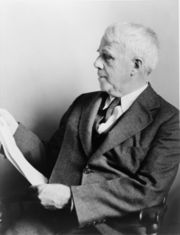
By Robert Frost (1874-1963, pictured above)


Whose woods these are I think I know. a
His house is in the village though; a
He will not see me stopping here b
To watch his woods fill up with snow. a

My little horse must think it queer b
To stop without a farmhouse near b
Between the woods and frozen lake c
The darkest evening of the year. b

He gives his harness bells a shake c
To ask if there is some mistake. c
The only other sound's the sweep d
Of easy wind and downy flake. c

The woods are lovely, dark and deep, d
But I have promises to keep, d
And miles to go before I sleep. d
Hence, the rhyme scheme is: aaba bbcb ccdc dddd

Last modified Nov, 1999 by M. O'Conner at http://www.millikin.edu/aci/crow/basics/frost3.html
To learn more about rhyme scheme on the Internet, visit Wikipedia, the free encyclopedia.

22 October, 2006

To Quote, To Summarize, or To Paraphrase? And how?


Editor's Note: The following handout pasted in from the Purdue University Online Writing Lab provides an excellent summary and review of fundamentals. Several links to the OWL are embedded in the article.


Quoting, Paraphrasing, and Summarizing

This resource was written by Purdue OWL.
Last full revision by Dana Lynn Driscoll.
Last edited by Dana Lynn Driscoll on September 10th 2006 at 11:49AM

Summary: This handout is intended to help you become more comfortable with the uses of and distinctions among quotations, paraphrases, and summaries. This handout compares and contrasts the three terms, gives some pointers, and includes a short excerpt that you can use to practice these skills.

Jump to listing of all of this resource's sections

Quoting, Paraphrasing, and Summarizing

This handout is intended to help you become more comfortable with the uses of and distinctions among quotations, paraphrases, and summaries. This handout compares and contrasts the three terms, gives some pointers, and includes a short excerpt that you can use to practice these skills.

What are the differences among quoting, paraphrasing, and summarizing?

These three ways of incorporating other writers' work into your own writing differ according to the closeness of your writing to the source writing.

Quotations must be identical to the original, using a narrow segment of the source. They must match the source document word for word and must be attributed to the original author.

Paraphrasing involves putting a passage from source material into your own words. A paraphrase must also be attributed to the original source. Paraphrased material is usually shorter than the original passage, taking a somewhat broader segment of the source and condensing it slightly.

Summarizing involves putting the main idea(s) into your own words, including only the main point(s). Once again, it is necessary to attribute summarized ideas to the original source. Summaries are significantly shorter than the original and take a broad overview of the source material.

Why use quotations, paraphrases, and summaries?

Quotations, paraphrases, and summaries serve many purposes. You might use them to . . .

  • Provide support for claims or add credibility to your writing
  • Refer to work that leads up to the work you are now doing
  • Give examples of several points of view on a subject
  • Call attention to a position that you wish to agree or disagree with
  • Highlight a particularly striking phrase, sentence, or passage by quoting the original
  • Distance yourself from the original by quoting it in order to cue readers that the words are not your own
  • Expand the breadth or depth of your writing

Writers frequently intertwine summaries, paraphrases, and quotations. As part of a summary of an article, a chapter, or a book, a writer might include paraphrases of various key points blended with quotations of striking or suggestive phrases as in the following example:

In his famous and influential work On the Interpretation of Dreams, Sigmund Freud argues that dreams are the "royal road to the unconscious" (page #), expressing in coded imagery the dreamer's unfulfilled wishes through a process known as the "dream work" (page #). According to Freud, actual but unacceptable desires are censored internally and subjected to coding through layers of condensation and displacement before emerging in a kind of rebus puzzle in the dream itself (page #s).

How to use quotations, paraphrases, and summaries

Practice summarizing the following essay, using paraphrases and quotations as you go. It might be helpful to follow these steps:

  • Read the entire text, noting the key points and main ideas.
  • Summarize in your own words what the single main idea of the essay is.
  • Paraphrase important supporting points that come up in the essay.
  • Consider any words, phrases, or brief passages that you believe should be quoted directly.

There are several ways to integrate quotations into your text. Often, a short quotation works well when integrated into a sentence. Longer quotations can stand alone. Remember that quoting should be done only sparingly; be sure that you have a good reason to include a direct quotation when you decide to do so. You'll find guidelines for citing sources and punctuating citations at our documentation guide pages.

18 October, 2006

What is poetry?????


That question has been answered many ways and provoked a lot of discussion. Believe it or not, English teachers will argue about what poetry "is" and what it is "not."

So with that question in mind, this unit introducing the concepts of "closed form" (also called "traditional poetry") and "open form" (often referred to as "modern" poetry) provides an occasion to explore exactly
what poetry is.

To that end, a recommended supplemental reading for you: The Wikipedia online encyclopedia's discussion of "poetry."
(Click here to link to Wikipedia.)

Reading the Wikipedia article will take you 10 or 15 minutes, but the overview is worth it. (You don't have to read every word of every part of it--Just skim. You'll know where to slow down and drink deeply and where you can just speed on by.)

You may find some ideas and/or information in the Wikipedia article that will come in handy on a future writing assignment.

For further discussion, consider posting the following:
  • share a web link to a helpful or interesting resource on poetry that you found
  • what you believe poetry is.
  • an original poem that you wrote
  • a copy of a poem that you find meaningful or special to you
  • anything else related to "what is poetry?"

13 October, 2006

Reading a Poem


(To the left: "Gaozongquatrain," a Chinese poem. Is this what you feel like you're reading when you tackle the 1002 assignments?)


Here are some tips from a couple of websites on reading poetry.

(From Bedford/St. Martin's LitLinks)

1. Who is the speaker?What does the poem reveal about the speaker's character? In some poems the speaker may be nothing more than a voice meditating on a theme, while in others the speaker takes on a specific personality.

2. Is the speaker addressing a particular person?If so, who is that person, and why is the speaker interested in him or her?

3. Does the poem have a setting?Is the poem occasioned by a particular event?

4. Is the theme of the poem stated directly or indirectly?Some poems use language in a fairly straightforward and literal way and state the theme, often in the final lines. Others may conclude with a statement of the theme that is more difficult to apprehend because it is made with figurative language and symbols.

5. From what perspective (or point of view) is the speaker describing specific events? Is the speaker recounting events of the past or events that are occurring in the present? If past events are being recalled, what present meaning do they have for the speaker?

6. Does a close examination of the figurative language (see "Glossary of Literary Terms") of the poem reveal any patterns?

7. What is the structure of the poem?Since narrative poems, those that tell stories, reveal a high degree of selectivity, it is useful to ask why the poet has focused on particular details and left out others. Analyzing the structure of a nonnarrative or lyric poem can be more difficult because it does not contain an obvious series of chronologically related events.

8. What do sound and meter (see "Glossary of Literary Terms") contribute to the poem?Alexander Pope said that in good poetry "the sound must seem an echo to the sense," a statement that is sometimes easier to agree with than to demonstrate.

9. What was your response to the poem on first reading?Did your response change after study of the poem or class discussions about it?

Also consider the following (From UWisconsin-Madison Writing Center):

*Read a poem with a pencil in your hand.

*Mark it up; write in the margins; react to it; get involved with it. Circle important, or striking, or repeated words. Draw lines to connect related ideas. Mark difficult or confusing words, lines, and passages.

*Read through the poem, several times if you can, both silently and aloud.

09 October, 2006

Peace Out!

Peace Out!
(Psalms 4:8)
By David L. Pulling
January 2005

Lie down,
Sleep,
Peace out,
Lord--
For peace I crave!
For I can’t
Peace myself
Together
Safely
Unless
You . . .

Peace!

Our next unit introduces poetry as a subject for discussion and composition. Do you have a poem that means a lot to you? Have you written a poem that you'd like for others to read? Why not post it as a comment right here for all of English 1002 (and the world) to see!

04 October, 2006

The Salem Witchcraft Trials: An Interactive Tale


Nathaniel Hawthorne's Puritan ancestors were directly involved in the Salem Witch Trials (not as witches, mind you). That was part of Hawthorne's past of which he was not particularly proud. As a result of the embarrassing family history, much of his literary endeavor was directed at exposing what Hawthorne perceived as the hypocrisy of Linkhis Puritan forbears.

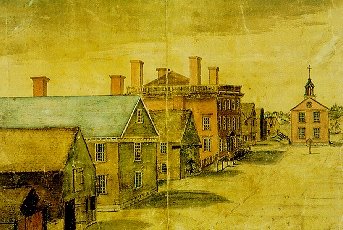
The photo above is Salem as it looked around the time of the Witchcraft Trials (and "Young Goodman Brown").

The link provided
here (just click here!) to a National Geographic interactive website on "Salem" will provide you with a riveting interactive experience from the time and place of "Young Goodman Brown." Without a time machine, this is about as an authentic visit to the historical Salem that you can get!

Enjoy, and by all means, post a response--Whether you're in English 1002 or not!
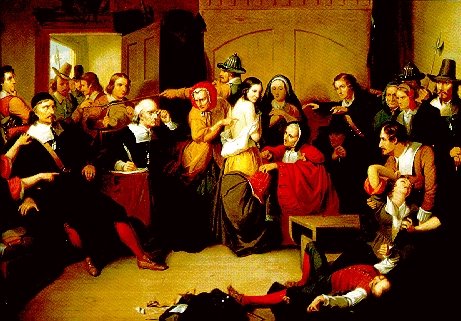
Pictured above is a famous painting of a witch being examined in the Salem trial.

02 October, 2006

An Online Interactive Reading of "Sweat"


Interested in what lies beneath the surface of ordinary words in "Sweat?"

Or in the author's intended significance for places and objects that never would have occurred to you as a casual reader?

Thanks to the web, click here to link to a version of the story produced by faculty and students at U. of South Florida with inserted hyperlinks to explanations of important terms, symbols, and objects in the story. Even though we move on from Hurston and "Sweat" to the next Module come October 4, some of you will choose to write about "Sweat." This version of the story might give you some rich insight. It's also an illustration of what a powerful resource you have at your disposal in the Internet.
Use resources like this to do your best!

If you like this material, find it interesting, or better yet, helpful, post a comment!

27 September, 2006

The Voice of Zora Neale Hurston


Click here to listen to audio clips of Zora Neale speaking (and even singing!) from the Online Classroom of the Florida Memory Project.


What do you think of that? Post a comment!

24 September, 2006

Complex (but simple) Symbolism: The Parables of Jesus

Having trouble understanding symbolism?

One of the easiest exercises to grasp how symbolism works--that is, objects or persons or things representing something beyond the literal object or person or thing--is to look at the familiar parables of Jesus found in the New Testament. Kennedy and Gioia include two very familiar biblical parables in your textbook:
        • "The Parable of the Good Seed" (Page 646)
        • "The Parable of the Prodigal Son" (Page 190)
Before you read the parables, look up both "allergory" and "parable" in the glossary of literary terms in your text (or look up the words on the Internet). You will how characters, places, and events in a parable have meaning on a literal level as well as a symbolic level.

If you'd like to look at a website that has links to parables as well as a discussion of what a parable is and how it relates to understanding symbolism, click here.

If you'd like to check out a multimedia version of the famous Parable of the Good Samaritan, click here.

Literary Analysis #3 will provide you an opportunity to write about symbolism in some of the selections you've read in the course, including the possibility of writing to explain one of these parables. If the idea of writing about one of the parables in Kennedy and Gioia's text appeals to you, be thinking along those lines. (But remember you have Lit. Analysis #2 to tackle before that! LOL).

Visitors to the blog are welcome to post comments. (Please, no anonymous posts--Let us know who you are.)

19 September, 2006

Symbolically Yours: Symbolism in Literature


A symbol in literature, as defined by Kennedy and Gioia, is "a person, place, or thing in a narrative [or poem] that suggests meanings beyond its literal sense.


In "A&P," for instance, the store represents more than a grocery store, for it's slogan "We have the best values in town" has a double meaning: in other words, the store is not just a place to buy groceries--the store, along with its manager Lengel, represents the solid community social traditions and moral values. It's more than just a store!


And in "Everyday Use," how about the quilts? Are they just old bed comforters? Or do the quilts, beyond their "everyday use," represent the idea of family values and tradition?

Steinbeck's story "The Chrysanthemums," is rich in symbolism, but let's leave that discussion for the Discussion Board. Happy reading!

Click here for additional readings about literary symbolism.

Question for general Blogservation (comment, in other words, from 1002 students or anyone else visiting the blog who has an opinion or an idea): What are some other common symbols you can think of from any source. . . for example, from our culture? from movies you have seen? from other familiar stories or novels? from music or art?

Painting Credits on this page:

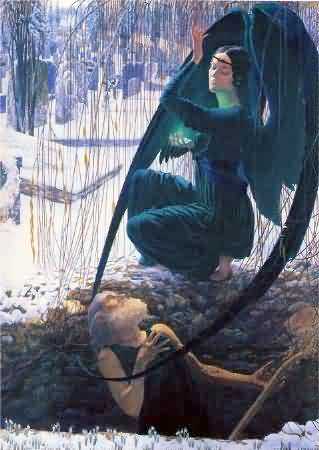
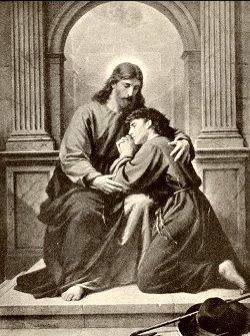
Deathgrave by Carlos Schwabe (above) and Safe in the Arms of Jesus (above right)

15 September, 2006

The Life and Times of Alice Walker

Click here to the Wikipedia free encyclopedia article about Alice Walker, her life and times. The article is rich with other links to websites, photos, and even videos. Check out Alice's life and times.

Can you relate anything you find in Walker's life story to "Everyday Use?" Post a comment to the blog.

Comments from non-English 1002 students are welcome! Post your blogservations!

13 September, 2006

The College Online Writing Lab: Check out the OWL!


Do you need wisdom for college writing assignments?
Visit the OWL!
(Online Writing Lab at Purdue University)
Click here to visit the Online Writing Lab.

You'll find resources to help with . . .
  • essay organization and structure
  • grammar and punctuation
  • MLA style
  • literary analysis
  • writing from research
  • paragraphing
  • sentence problems
  • anything else that ails you as a writer!
Visit the site. Post a comment here on the blog about what you find helpful or useful so others can get help, too!

10 September, 2006

Improve your active reading skills!


"Qualty reading precedes quality writing."
--David Pulling

Reading assignments for English 1002 are more difficult than reading your hometown newspaper!

How have you adapted your reading style to meet the challenge?

Click here for a link to a syllabus from a college literature course that includes practical suggestions and advice on active reading. The literature teacher that designed this site had students like YOU in mind!

Not only does the syllabus have good information, it also includes links to other resources that may help you. Try it out. If you try some reading strategy that works, post a comment.

06 September, 2006

To Believe, or Not to Believe . . . The Unreliable Narrator!


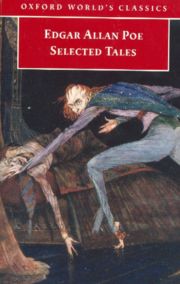
The first two reading selections this semester--Updike's "A&P" and Poe's "The Tell-Tale Heart"--are both related from the view points of unreliable narrators. Since that's one of the writing options for Literary Analysis #1, why not blog it? Check out the link to a Wikipedia article (click here) with a more prolonged discussion of this literary term than you'll find in your textbook.

04 September, 2006

The Death of Edgar Allan Poe


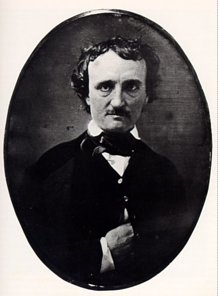
No other writer in our lineup of ten literary modules this semester has so much myth and fantastical tales surrounding him than Edgar Allan Poe.

Who or What was he?

A drug addict?
Couldn't handle booze?
An incestuous pervert?
A loser who couldn't finish a job?

Or was he a talented writer and practical businessman who knew that twisted stories were marketable to a reading public thirsty for tales from the dark side?

Well, English 1002 (or anybody else happening along this blog), what do you think may be the answer to those questions?

Don't simply base your judgment on reading "The Tell-Tale Heart." Do some research and backgound investigation. Look at the big picture. Then come back with an informed response. By all means, post your comments!

For a link to info. about Poe's mysterious death, which has helped to fuel many of the Poe legends and myths, click
here.

02 September, 2006

THE GREAT ATLANTIC AND PACIFIC TEA COMPANY: A&P


(David Pulling's English 1002 class at LSU-Eunice is reading and discussing John Updike's short story "A&P.")

Updike's story is set in 1961 in an A&P supermarket chain store. In the late 1960's, A&P was the largest national supermarket chain in the country. A&P stores were common in South Louisiana in those days, too--I remember a store in Ville Platte as recently as the late 80's or early 90's, in fact. Of course, I worked at an A&P in my home town of Covington during the late 60's and early 70's when I was in high school and the early years of college. A&P's were common throughout the state in those days, with a major warehouse facility on Jefferson Highway in Metairie.

Just so you'll know, A&P (short for "The Great Atlantic and Pacific Tea Company") is still around in other parts of the country, although I haven't seen a store in South Louisiana in years. You can visit their web site at http://www.apsupermarket.com/.

The A&P store fronts in the 60's and 70's were marked by a distinctive colonial style architecture--very appropriate to support Lengel's "traditional American values" theme! If you're observant, you can still see that colonial architecture in abandoned strip malls throughout small Louisiana towns where A&P stores used to be located.

Does anybody remember an A&P supermarket besides the "old" teacher?

25 August, 2006

Updike, Downdike, All-arounddike!


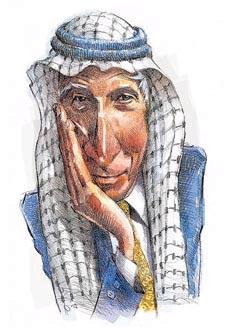
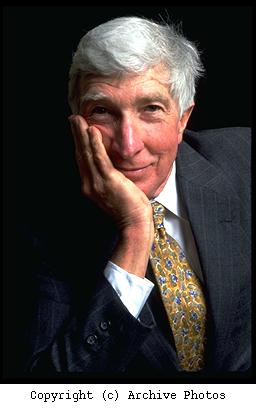
English 1002 begins the semester reading and writing about John Updike. (That's John smiling lovingly in the pictures, the one on the left "fer real," the other obviously a cariciature (Ooh, cariciature--that's a vocabulary word! Who knows what that means?)

Students in the class will have the opportunity to discuss Updike and the representative short story "A&P" in the course's Blackboard discussion board, but that's a closed forum. This blog is an open forum! In other words, anybody in the world--not just students in English 1002 class-- can post a comment, or reply to someone else's comment--right here!

So let's see what happens! Whoever you are-- 1002 student, literary critic, common Joe/Jane on the street--Have you read Updike? Whatcha think of Updike? And if that doesn't interest you, whatcha think of life? the meaning of life? The English 1002 class you're in now, or a second semester comp. class you took a long time ago?

Post one, post all! Join the Updike free-for-all!